Article: Why Does My Heel Hurt — and What Is Actually Going On?
Why Does My Heel Hurt — and What Is Actually Going On?
Why Does My Heel Hurt — and What Is Actually Going On?
If your first steps out of bed in the morning make you wince, you are not alone — and there is often more to it than "plantar fasciitis." Here is what may be really happening, and why it matters for how you treat it.
It's probably not just "plantar fasciitis"
You may have been told you have plantar fasciitis. It's one of the most commonly diagnosed conditions in podiatry, and the name has become shorthand for almost any heel pain. But here's the thing — that label is often incomplete, and it matters to how we may best treat it.
The plantar fascia is one structure in a complex neighbourhood. The heel also houses the heel fat pad, the origins of multiple intrinsic foot muscles, the calcaneus (heel bone), and the Achilles tendon. Any of these, or several at once, can be under stress. Treating only the fascia, can mean missing everything else.
Throughout this blog we'll use the broader term plantar heel pain — because that is what it is, and because understanding all the structures involved is what can lead to better treatment outcomes.
If you only treat the plantar fascia, you may miss stressed bone, a thinning fat pad, weakened intrinsic muscles, or restricted ankle mobility. A more complete picture leads to a more effective recovery.
A busy neighbourhood — all in one small region
The base of the calcaneus — the heel bone — is one of the most structurally loaded regions in the human body. Several distinct structures converge here, each contributing to healthy foot function and each capable of becoming a source of pain when overloaded. Understanding who's who in this neighbourhood is the foundation for understanding why your heel hurts.
A specialised, compartmentalised cushioning layer directly beneath the calcaneus. Its sole job is to absorb and disperse impact forces at heel strike. It can thin with age, prolonged loading, or certain autoimmune diseases — and once thinned, does not reliably regenerate.
The calcaneus serves as the attachment point for both the plantar fascia, intrinsic foot muscles and the Achilles tendon. When these soft tissue structures are repeatedly overstressed, they can create forces on the bone itself leading to bone bruising (seen as bone marrow oedema on MRI).
A broad band of dense connective tissue arising from the medial & lateral tubercle of the calcaneus, fanning forward across the sole toward the toes. It functions as a passive tensioning structure supporting the arch during walking and running, and is functionally continuous with the Achilles tendon via the calcaneal periosteum (bone lining).
Small but important muscles — including flexor digitorum brevis and abductor hallucis — originate from the calcaneal tuberosity alongside the plantar fascia. When weak or fatigued, these muscles leave the plantar fascia to carry load it was never designed to manage alone.
Restricted ankle mobility from a tight Achilles-calf complex can increase tensile stress through the heel region. When walking, a tight Achilles tendon & its muscles can prematurely lift the heel thus placing greater and longer loads on the plantar fascia.

What makes plantar heel pain so variable — and sometimes so stubborn — is that any one of these structures can be the primary problem, or several can be involved simultaneously. Which ones, and to what degree, differs from person to person.
The causes are not the same for everyone
This is one of the most important things to understand about plantar heel pain: the path that leads to it is different for almost every person. The structures involved, the forces driving the load, and the contributing factors from footwear, lifestyle, and whole-body movement all vary. Here are the most common contributors — any one of which, or several in combination, may be relevant to you.
Hard surfaces, thin-soled footwear, or a heavy heel-strike pattern places repetitive compressive load on the heel. Over time this can stress the plantar fat pad, increases bone impact forces and lead to rapid foot loading which may increase the rate and force of foot pronation (foot flattening). Example: a person who works long shifts on concrete floors in flat, thin-soled shoes.
With age, our collagen looses its elasticity - that's why we get wrinkles on our face and our collagen in our feet is no different.. The fat pad loses thickness and its ability to cushion impact forces. The arch structures like the plantar fascia are not as springy and our foot strength decreases. These are mostly structural changes that cannot be reversed (although foot strength can be improved) — which is why external cushioning & support becomes a long-term management tool rather than a short-term fix.
The small muscles inside the foot are meant to actively support the arch and stabilise the front of your foot at push off . They share the load on the foot with the plantar fascia. When weak or poorly recruited, the passive structures — fascia and bone — carry more than their share. In our plantar pressure assessments, poor digit (toe) engagement is one of the most consistent findings we see across heel pain presentations. (See our related blog: Foot Strength and Why It's Essential.)
When the ankle cannot dorsiflex adequately — often due to calf tightness — the body compensates by dorsiflexing through the midfoot instead. This collapses the arch under load and increases tensile strain at the plantar fascia origin. Calf stretching must be performed in the correct alignement— feet pointing straight forward with the arch rolled up slightly — to restore true ankle range.
Unsecured footwear — mules, slides, backless sandals — requires the toes to grip to keep the shoe on. Over time this suppresses normal intrinsic function and transfers more load onto the fascia and calcaneal origin. Example: someone who works from home in slides on timber floors without arch support for most of the day.
A painful hip, knee, or ankle on one side can cause a person to offload that limb and load more heavily onto the opposite heel — increasing both the rate and magnitude of heel strike on the contralateral side. The heel takes the brunt of a compensation pattern it had nothing to do with creating. Example: someone recovering from a knee replacement who develops new-onset heel pain on the opposite side within weeks of surgery.
"Plantar heel pain is rarely one problem. It is usually several factors arriving at the same address — and the combination is different for every person."
Designed to address multiple factors — not just one
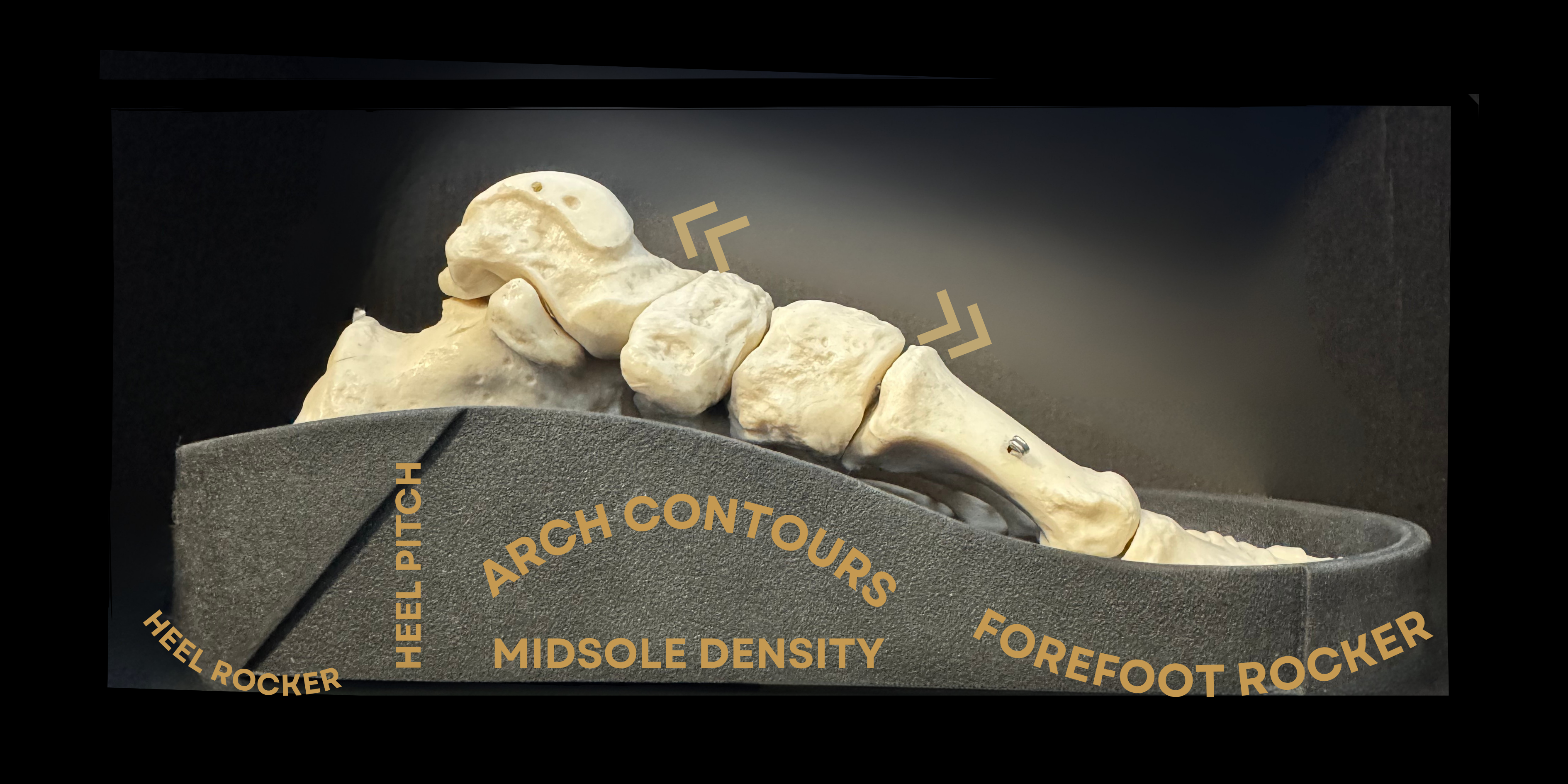
Because plantar heel pain involves multiple structures and multiple contributing factors, the footwear features that can help manage the excessive forces and poor foot function all need to work together. In our ANATOMICA sandal, here is what each design feature does and why it matters in plantar heel pain.
Cushioning under the heel absorbs impact and supplements the natural fat pad — reducing compressive forces on the calcaneus at heel strike. However, cushioning is a balancing act: too little and the bone and fat pad are underprotected; too much and the unstable surface increases intrinsic muscle workload, which can fatigue the muscles so that they strain at their calcaneal origins and compound fascial load.
The density of our EVA midsole has been chosen to sit at the Goldilocks point — firm enough to maintain stability and muscle engagement, compliant enough to meaningfully reduce heel impact.
The deep heel cup serves two functions for heel pain specifically. First, it mechanically contains the fat pad beneath the calcaneus — keeping it centralised and preventing it from spreading sideways under load, which is where a thinning fat pad begins to fail. Second, by cupping the heel rather than just supporting it from below, load is dispersed across a broader surface area rather than concentrated at the central plantar point. Both effects reduce peak pressure on the most sensitised tissue.
Elevating the heel slightly reduces tensile load through the Achilles tendon — placing the soft tissue in a position of relative ease during standing and walking. For those whose heel pain is partly driven by reduced ankle dorsiflexion or calf tightness, this positional unloading is clinically meaningful during the recovery phase.
Support across the longitudinal and transverse arches reduces midstance tension in the plantar fascia — particularly important for flatter foot types where arch collapse under load dramatically increases fascial strain. By providing a structural scaffold during stance phase, the footbed reduces demand on both the fascia and intrinsic muscles to maintain arch integrity alone.
A secured heel means the toes do not need to grip the shoe — allowing the intrinsic muscles to function normally and progressively rebuild their load-sharing role. A small design detail with a meaningful rehabilitation benefit, particularly for those who have been wearing slip-on footwear for extended periods.
Protect, restore, rebuild — all at the same time
Plantar heel pain responds best when you manage the load, restore tissue length, and rebuild muscular capacity — ideally in parallel rather than sequentially.
Supportive footwear from the first step of the day — including at home. Orthotics in quality shoes throughout waking hours. Reduce prolonged barefoot time on hard floors during the recovery phase.
Performed correctly to restore proper ankle range. This reduces compensatory midfoot stress and the tensile load it places on the plantar fascia origin. Consistency over weeks matters more than intensity.
Intrinsic muscle rehabilitation progressively transfers load from the passive fascia back to the muscles designed for the job. The ANATOMICA footbed support and calf stretching can buy time for this to happen — they do not replace it.
There are other treatment modalities for plantar heel pain — some very effective for the right presentation — but they are substantial topics in themselves. What we can say is that no treatment works as well when foundational load management is not in place. Getting the footwear right is not optional. It is the base on which everything else is built.
"Stretch, strengthen, support — and start from the moment your feet hit the floor."
Podiatric science applied to footwear design. Orthotic sandals engineered for foot posture, function, and lower limb health.